Deb Haaland and Local Conservation Leaders on the Future of New Mexico’s Lands
- mary anne potts
- Apr 6
- 4 min read
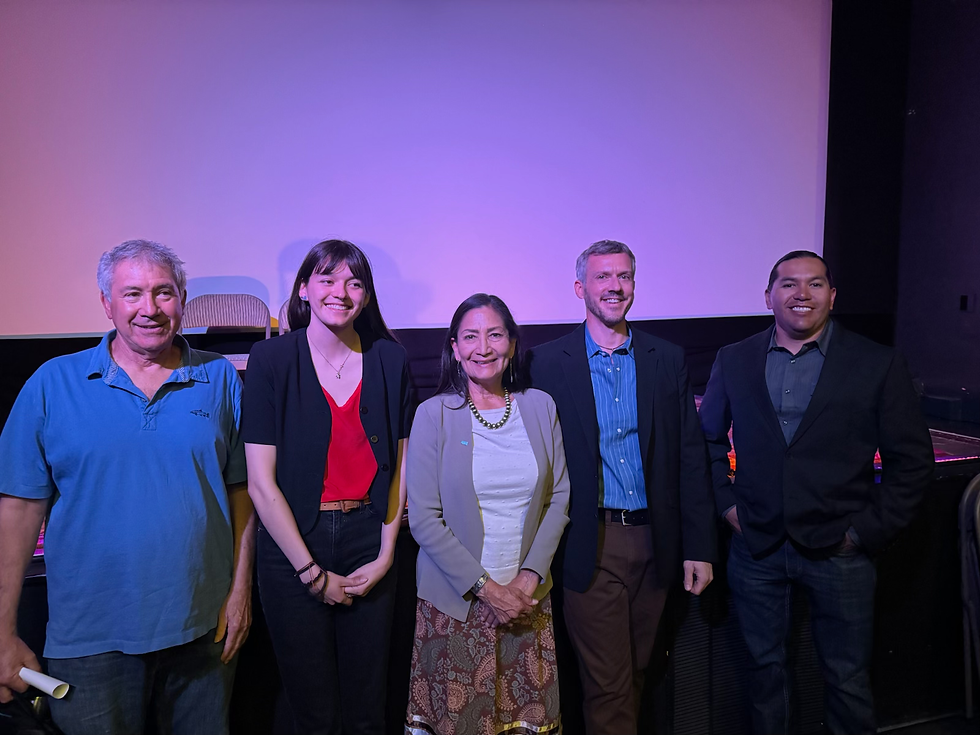
"Our experiences when we are young—like fishing with a parent or working in a field with a grandfather—shape who we are and influence our sense of obligation to the Earth,” says Deb Haaland former U.S. Secretary of the Interior and a candidate for governor of New Mexico at Monday’s sold out screening of Preserved at the Guild Cinema in Albuquerque, New Mexico.
Film director Ben Clark led an inspiring panel discussion featuring a diverse group of conservation leaders. The conversation bridged the gap between national policy and local grassroots efforts, featuring Deb Haaland, Harris Klein (Trout Unlimited), Lance Bernal (Vermejo), and Anabella Miller (Western Landowners Alliance). The panel explored the vital importance of outdoor education, the technical challenges of river restoration, and the power of storytelling in protecting New Mexico's natural landscapes for future generations.
The Conversation
Ben Clark: Deb, looking at land management on a national scale, what are some of the partnerships you’ve seen successfully create conservation we can all be proud of?
Deb Haaland: I am particularly proud of tribally led conservation efforts, such as Avi Kwa Ame in Nevada. Unlike the history of the federal government taking over spaces and removing tribes from ancestral lands to create parks, Avi Kwa Ame was driven by the community and stakeholders coming to us with their vision. It wasn't the federal government saying, "We know best"—the community knew what was best for them. We saw similar success with the Grand Canyon National Monument and the 10-mile buffer zone around Chaco Canyon. It is vital that we recognize these lands as ancestral homelands and respect that history.
Ben Clark: I actually woke up in Chaco Canyon this morning, but 25 years ago I’d be waking up in a tent as a guide on Rainer. Why is it so important to provide opportunities for people to work in these landscapes and develop stewardship beyond just science?
Deb Haaland: It is a sustainable industry where people can truly make a living and provide for their families. Plus, it’s fun. I’ve proposed an "Every Child Outdoors" initiative because I believe every child in public school should have outdoor classroom time. In the younger grades, they can backpack or visit our acequias. In the upper grades, they can learn how to manage those acequias or work in the fields.
We need to inspire the next generation of land stewards. Our experiences when we are young shape who we are. I remember being a small child and my grandfather would take me out into the cornfield. He would be hoeing the weeds, and he’d give me a little hoe and I would stay right there with him. Those experiences influence our sense of obligation to the Earth. It's like you have to pay it forward because future generations are relying on the decisions we make today. We've done so much damage to our country, but it’s astounding how quickly it can be rejuvenated if we actually give a damn.
Ben Clark: When we look at stewardship, I think of something Kris Tompkins, who is featured in the film, once told me. She said that to truly preserve a place, you have to find the "local geniuses"—the people who already know how to steward the land—and instead of moving them off, you invite them in as living historians. Harris, how does Trout Unlimited work with those local geniuses on the ground here?
Harris Klein: Everyone thinks we’re a fishing organization, but we’re actually a conservation organization that fishes. We work with eight agencies to put rivers back into their original channels after they've been damaged by forest fires and floods. We have 14 projects across New Mexico right now, including a major restoration in the Gila Wilderness at Willow Creek. Because it's a wilderness area, all work is done manually—we rely on young New Mexico State students to do the heavy lifting of boulders while we "supervise."
Ben Clark: Lance, speaking of students, what research is happening at Vermejo and what is on the horizon for those "local geniuses" in training?
Lance Bernal: We are currently researching Pinion Jays to see which forestry practices benefit them most. Additionally, all Turner properties are joining the Turner Institute of Eco Agriculture to engage with land grant universities for research. Most exciting is the recent acquisition of the 50,000-acre Dawson Elk Valley Ranch. It will be managed by a tribally led group and serve as an outdoor classroom for Native American students, with our staff helping through education and land management.
Ben Clark: That Dawson property is such an incredible piece of land with a heavy history. If you look up the Dawson Cemetery, you’ll find the history of the mining accidents that left a "fatherless town" behind. It’s an incredible story we couldn't fit in the film, but it's exciting to see it transition. Lance, what role do you see that property having in the future of external conservation?
Lance Bernal: Like the film, it’s about moving forward. The goal for Dawson is to make it an outdoor classroom for Native American students. My staff in natural resources are going to help in whatever way we can—whether it's through education, land management practices, or hunt programs—anything they need or want us to help with, we’re going to do that.
Ben Clark: Anabella, as a young person in this field, what was it that drew you toward this career path?
Anabella Miller: I grew up on the Rio Mora National Wildlife Refuge, which started as a private ranch. My dad was a biologist, and I spent my childhood watching the reintroduction of species. It wasn't until university that I realized it was a career path where I could work to make the world better. Now, with the Western Landowners Alliance, we are building a New Mexico-specific newsletter to bridge the gaps between different conservation efforts. You don’t have to be a landowner to join us—we want everyone to feel empowered to participate.


Comments